Front Desk : +91 9798215886   | Address : MIG-207, Lohiya Nagar, Kankarbagh, Malahi Pakri , PATNA 800020 (Bihar).

Heart Failure Treatment in Patna

Heart Failure Treatment in Patna

Heart Failure Treatment in Patna: A Guide to Comprehensive Cardiovascular Care

Heart failure is a chronic, progressive medical condition in which the heart muscle is unable to pump a sufficient volume of blood to meet the body’s physiological need for oxygen and nutrients. Rather than a sudden cessation of heartbeat, heart failure typically develops gradually, frequently presenting as a secondary complication of underlying conditions such as severe hypertension, coronary artery disease, structural valve defects, or unmanaged diabetes.

In Patna and across Bihar, the rising prevalence of these metabolic disorders has contributed to an increasing incidence of heart failure. Effectively managing this complex condition requires a structured, evidence-based approach centered on Guideline-Directed Medical Therapy (GDMT), continuous hemodynamic monitoring, and, when indicated, advanced device implantations or cardiothoracic surgical interventions.

For patients seeking structured medical management for heart failure, the Ford Hospital network provides a comprehensive clinical ecosystem. In strict adherence to the National Medical Commission (NMC) 2026 guidelines regarding factual, transparent, and evidence-based medical communication, the following is an objective overview of our network’s healthcare facilities designed to support long-term heart failure management and acute stabilization.

Integrated Cardiovascular Facilities Across the Network

Effectively treating heart failure requires a multidisciplinary continuum of care. Because heart failure is predominantly a chronic condition managed over the long term, our network is structured to emphasize robust outpatient monitoring, supported by inpatient emergency stabilization and specialized mechanical interventions when the disease progresses.

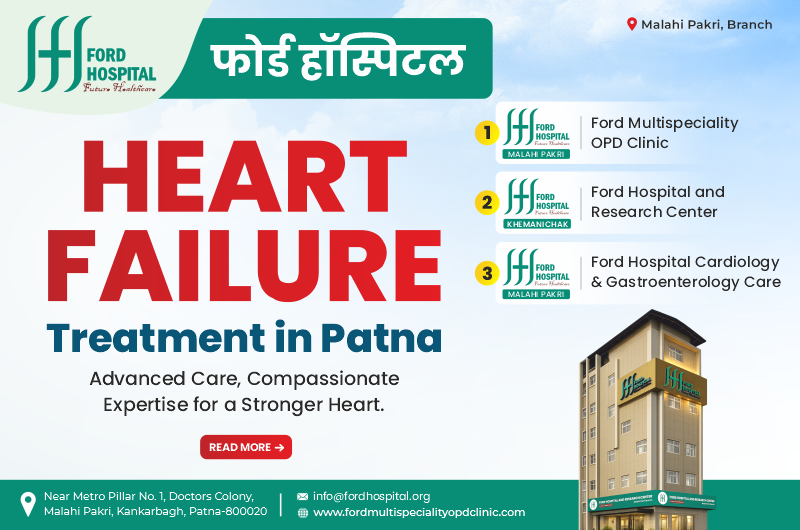
1. Ford Multispeciality OPD Clinic (The Frontline of Heart Health)

The foundational management of chronic heart failure relies heavily on careful outpatient monitoring, continuous medication titration, and patient adherence to lifestyle modifications. The Ford Multispeciality OPD Clinic serves as the primary access point for routine cardiovascular follow-ups and the optimization of Guideline-Directed Medical Therapy (GDMT).

  • Medication Titration: Current clinical guidelines recommend that patients with reduced ejection fraction be treated with a specific combination of foundational medications (including beta-blockers, ACE inhibitors/ARNIs, MRAs, and SGLT2 inhibitors). The clinic provides dedicated consultations to safely adjust these dosages based on regular blood tests and blood pressure monitoring.
  • Non-Invasive Diagnostics: Routine structural assessments via 2D Echocardiography, alongside 12-lead ECG and Holter monitoring, are utilized to track the heart’s pumping efficiency (ejection fraction) and detect dangerous arrhythmias before they cause hospitalization.
  • Preventive Care & Rehabilitation: Ongoing consultations focus on monitoring daily weights to prevent fluid overload, adjusting oral diuretic (water pill) doses, and providing supervised cardiac rehabilitation plans.

Outpatient Specialty Directory:

2. Ford Hospital And Research Center — Comprehensive Tertiary Healthcare Hub

When chronic heart failure abruptly worsens—a condition known as acute decompensated heart failure—patients require immediate inpatient stabilization. Functioning as the primary multispeciality inpatient center of the network, Ford Hospital & Research Center (located near New Bypass, Khemnichak, Patna) provides the intensive care and surgical infrastructure necessary to manage these critical episodes.

  • Emergency & Intensive Care: The facility features a 24/7 dedicated emergency response team and Intensive Coronary Care Units (ICCU) equipped for continuous mechanical ventilation, invasive hemodynamic monitoring, and intravenous diuretic therapy to rapidly relieve severe fluid in the lungs (pulmonary edema).
  • Multisystem Management: Heart failure significantly impacts renal function. Direct coordination with the in-house Nephrology department ensures careful monitoring of kidney health during aggressive diuretic therapy and the management of cardiorenal syndrome.
  • Cardiothoracic Surgical Support: For heart failure induced by ischemic heart disease or valvular dysfunction, the hospital houses surgical facilities for Coronary Artery Bypass Grafting (CABG) and structural valve repair or replacement to address the root mechanical cause of the failure.

Multidisciplinary Clinical Directory at Ford Hospital:

  • 24×7 Emergency & Trauma Care — The absolute frontline for acute myocardial infarctions (heart attacks), sudden cardiac arrest, and complex cardiogenic shock requiring immediate hemodynamic stabilization.
  • Cardiology & Angioplasty Centre — The core surgical hub for clearing blocked arteries via primary emergency stenting and managing severe, life-threatening heart rhythm disorders.
  • Cardiac Surgery (CABG, Valve) — Providing highly advanced “beating heart” bypass surgeries, complex heart valve replacements, and surgical repairs for structural heart defects.
  • Neurology & Neurosurgery – including Brain-Stroke Unit — Crucial for managing the severe stroke risks associated with Atrial Fibrillation (irregular heartbeat) and sudden drops in blood pressure to the brain during cardiac events.
  • Gastroenterology & Hepatology — Treating severe gastric overlaps (like extreme acid reflux) that often mimic the chest pain of heart attacks, preventing fatal misdiagnoses, and managing liver congestion caused by right-sided heart failure.
  • Urology & Kidney-Stone Clinic — Managing structural urinary issues, particularly for elderly male cardiac patients who cannot safely stop their life-saving blood-thinning medications for standard surgeries.
  • Nephrology & Dialysis Centre — Protecting the kidneys from “Cardio-Renal Syndrome,” a deadly condition where severe heart failure directly causes the kidneys to shut down, requiring immediate dialysis.
  • Critical Care & ICU — Fully equipped with advanced ventilators, continuous hemodynamic monitoring, and Intra-Aortic Balloon Pumps (IABP) to mechanically keep the heart pumping in highly unstable patients.
  • Internal Medicine — Managing complex, multi-system infections that can directly attack and destroy the heart valves, a dangerous condition known as infective endocarditis.
  • Endocrinology & Diabetes — Diabetes is the ultimate catalyst for cardiovascular destruction. Our endocrinologists strictly manage HbA1c levels to protect the coronary arteries from further plaque buildup.
  • General & Laparoscopic Surgery — Providing comprehensive surgical backup if cardiac patients suffer from overlapping physical traumas or acute abdominal emergencies.
  • Orthopedics & Trauma – Knee Replacement — Restoring pain-free joint mobility so recovering cardiac patients can safely engage in the cardiovascular treadmill exercise absolutely required for heart rehabilitation.
  • Physiotherapy & Rehabilitation — Delivering specialized, heavily monitored Cardiac Rehab programs to help heart attack survivors safely rebuild their cardiovascular endurance and heart muscle strength.
  • Pulmonology & Respiratory Care — Treating severe pulmonary edema (fluid violently backing up into the lungs) caused by left-sided congestive heart failure.
  • ENT (Ear-Nose-Throat) — Managing severe Obstructive Sleep Apnea, which is a major, hidden trigger for highly dangerous nighttime cardiac arrhythmias and sudden high blood pressure spikes.
  • Dietetics & Nutrition — Providing highly customized, strict meal plans designed specifically to manage sodium intake, drastically lower LDL cholesterol, and reduce overall body weight for optimal cardiac recovery.
  • Plastic & Reconstructive Surgery — Assisting in complex wound management and sternal closure reconstruction following major open-heart bypass surgeries to prevent deep chest infections.
  • Obstetrics & Gynaecology – Maternity / Pregnancy Care, Women’s Health — Managing high-risk pregnancies that are complicated by maternal congenital heart defects, arrhythmias, or severe, heart-straining preeclampsia.
  • Pediatrics & Child Hospital — Treating congenital heart disease, murmurs, and structural cardiac defects in infants, toddlers, and young children.
  • Piles & Proctology Clinic — Providing minimally invasive laser treatments for severe hemorrhoids in cardiac patients who are on strict, lifelong blood-thinner protocols and cannot risk traditional surgery.

3. Ford Hospital Cardiology & Gastroenterology Care

Operating as a focused specialty facility, Ford Hospital Cardiology & Gastroenterology Care (located at Malahi Pakri, Kankarbagh, Patna) is structured to manage targeted device interventions and intersecting metabolic complications associated with advanced-stage heart failure.

  • Device Therapy for Heart Failure: For patients with a reduced ejection fraction who remain symptomatic despite optimal medication, this center’s Cath Lab is equipped for the implantation of Cardiac Resynchronization Therapy (CRT) devices and Implantable Cardioverter-Defibrillators (ICD), following established clinical guidelines to improve cardiac rhythm and prevent sudden cardiac arrest.
  • Advanced Hemodynamic Support: The facility is equipped with advanced cardiopulmonary support mechanisms to assist patients with failing heart and lung function during severe exacerbations.
  • Gastrointestinal Coordination: Severe right-sided heart failure often causes hepatic (liver) congestion and gastrointestinal issues due to systemic fluid retention. Collaboration with clinical gastroenterologists ensures the safe management of these secondary metabolic complications.

Explore Our Dedicated Core Services:

The Cardiovascular Medical Team

The clinical management of heart failure requires careful diagnostic monitoring and an evidence-based approach to medication and device therapy. In compliance with NMC guidelines prohibiting superlative rankings of medical practitioners, Ford Hospital provides a team of experienced clinicians focused on standardized patient care:

Recognizing the Symptoms of Decompensated Heart Failure

Patients diagnosed with heart failure, or those at risk, must monitor for signs of acute decompensation. Individuals experiencing the following symptoms should seek immediate medical evaluation at an emergency center:

  • Severe Dyspnea (Shortness of Breath): Breathlessness that occurs even at rest, or suddenly waking up at night struggling to breathe (paroxysmal nocturnal dyspnea).
  • Rapid Edema (Swelling): Sudden, noticeable swelling in the legs, ankles, feet, or abdomen, often accompanied by rapid weight gain (e.g., more than 1.5 to 2 kg in a few days) due to fluid retention.
  • Persistent Fatigue: Unexplained, profound exhaustion that severely limits normal daily activities.
  • Palpitations: Noticeably rapid, irregular, or fluttering heartbeats.
  • Orthopnea: The inability to breathe comfortably while lying flat, frequently requiring multiple pillows to sleep.

Evidence-Based Management of Heart Failure

Cardiovascular specialists recommend strict adherence to medical protocols and lifestyle modifications to manage heart failure effectively and reduce the frequency of hospital admissions:

  1. Medication Adherence: Strictly follow the Guideline-Directed Medical Therapy (GDMT) prescribed by your cardiologist. Do not alter doses of diuretics or foundational therapies without clinical guidance.
  2. Sodium & Fluid Restriction: Limit dietary sodium intake to prevent fluid retention. Depending on the clinical stage, cardiologists may also strictly restrict daily fluid intake.
  3. Daily Weight Monitoring: Weigh yourself daily at the same time (preferably in the morning after using the restroom) to detect early signs of fluid retention before severe swelling or breathlessness occurs.
  4. Physical Activity: Engage in balanced, physician-approved cardiac rehabilitation exercises to maintain cardiovascular endurance without overstraining the heart.
  5. Symptom Tracking: Keep a careful log of your blood pressure, heart rate, and any new symptoms to discuss during your outpatient clinic visits.

Frequently Asked Questions

1. How is heart failure diagnosed at Ford Hospital?

Diagnosis is confirmed through a combination of clinical evaluation, specific blood tests (such as BNP or NT-proBNP markers which indicate heart stress), 12-lead ECG, and 2D Echocardiography, which measures the heart’s ejection fraction (pumping efficiency).

2. Can heart failure be completely cured?

Heart failure is a chronic condition that generally has no absolute cure, unless it is caused by a reversible issue like a valve defect that can be surgically repaired. However, with appropriate medical management, device therapies, and lifestyle modifications, symptoms can be effectively controlled, and the progression of the disease can be managed.

3. What is a CRT or ICD device?

Cardiac Resynchronization Therapy (CRT) is a specialized pacemaker that helps the lower chambers of the heart beat in a coordinated manner to improve pumping efficiency. An Implantable Cardioverter-Defibrillator (ICD) is a device that monitors for life-threatening arrhythmias and delivers a shock to restore a normal rhythm.

4. Why is kidney function monitored during heart failure treatment?

The heart and kidneys are highly interconnected. Medications used to treat heart failure, particularly diuretics (water pills), affect fluid volumes and renal function. Regular blood tests are required to ensure the kidneys remain stable during aggressive therapy.

5. How can I schedule a consultation for heart failure management?

Outpatient and specialty consultations can be scheduled through the Ford Hospital reception desk, via the central coordination contact at +91 9798215884, or through the official website portal.
SHARE THIS ARTICLE

Leave a Reply

Your email address will not be published. Required fields are marked *