Front Desk : +91 9798215886   | Address : MIG-207, Lohiya Nagar, Kankarbagh, Malahi Pakri , PATNA 800020 (Bihar).

Heart Problem Treatment in Patna

Heart Problem Treatment in Patna

Heart Problem Treatment in Patna: A Clinical Guide to Diagnosing and Managing Cardiovascular Disorders

When a patient or family member is told they have a “heart problem,” the phrase often triggers immediate anxiety—largely because the term is used to describe several distinct medical conditions. In clinical cardiology, the human heart operates simultaneously as a muscular pump, a pressurized vascular network, a set of mechanical one-way valves, and an electrical signaling system. A “heart problem” can originate in any one of these four physiological systems, and the required treatment—whether daily oral medication, a wrist-access catheter procedure, a pacemaker, or open-heart surgery—depends entirely on pinpointing which mechanism is affected.

Across Patna and Bihar, clinicians are diagnosing cardiovascular conditions at increasingly younger ages. Factors such as uncontrolled hypertension, Type 2 diabetes, visceral obesity, high-sodium diets, tobacco consumption, and chronic stress accelerate arterial aging and myocardial strain. Because many cardiac disorders progress silently for years before causing an acute emergency, early clinical evaluation is the single most effective safeguard for long-term survival.

In strict adherence to the National Medical Commission (NMC) 2026 guidelines for factual, transparent, and non-promotional medical education, this guide breaks down the four primary categories of heart problems, their warning symptoms, evidence-based treatments, and how the Ford Hospital network organizes cardiac care across three specialized facilities in Patna.

Decoding “Heart Problems”: The 4 Core Clinical Categories & Their Warning Signs

Before starting treatment, a cardiologist determines which functional component of the heart is compromised. Understanding these four categories helps patients recognize why specific diagnostic tests and therapies are prescribed:

1. The “Plumbing” System: Coronary Artery Disease (CAD) & Blockages

The coronary arteries supply oxygen-rich blood to the heart muscle itself. When cholesterol deposits (atherosclerotic plaques) narrow these vessels, blood flow becomes restricted (myocardial ischemia).

  • Key Symptoms: Chest heaviness, squeezing, or burning (angina) during brisk walking, climbing stairs, or emotional stress; pain radiating to the left shoulder, inner arm, neck, or jaw; or sudden, severe chest pressure at rest indicating an acute myocardial infarction (heart attack).

2. The “Electrical” System: Cardiac Arrhythmias & Conduction Blocks

Specialized electrical pathways control the rhythm and speed of every heartbeat. Scar tissue, electrolyte imbalances, or age-related degeneration can cause the heart to beat too fast (tachycardia), too slow (bradycardia), or irregularly (atrial fibrillation).

  • Key Symptoms: Fluttering, racing, or skipped heartbeats (palpitations); unexplained dizziness or lightheadedness; sudden blackouts or fainting spells (syncope); and sudden weakness.

3. The “Mechanical Pump”: Heart Failure & Cardiomyopathy

When the heart muscle becomes weakened after a prior heart attack, or stiffened due to long-standing high blood pressure, its pumping efficiency—measured clinically as Left Ventricular Ejection Fraction (LVEF)—declines.

  • Key Symptoms: Shortness of breath (dyspnea) during minor exertion or while lying flat on your back; waking up gasping for air at night; persistent physical exhaustion; and visible fluid swelling (edema) in the feet, ankles, legs, or abdomen.

4. The “Structural Doorways”: Valvular & Congenital Heart Disease

Four valves keep blood flowing forward through the heart’s chambers. Rheumatic fever, congenital anomalies, or age-related calcium buildup can cause a valve to narrow (stenosis) or leak backward (regurgitation).

  • Key Symptoms: Progressive breathlessness on exertion, fatigue, heart murmurs detected during a stethoscope examination, and occasional chest tightness or ankle swelling.

Emergency Clinical Triage Rule: If a patient experiences unyielding chest pressure lasting longer than 10 to 15 minutes at rest, cold sweats, sudden severe breathlessness, or fainting, do not wait for an outpatient appointment. Transport the patient immediately to a 24×7 emergency cardiac center to preserve heart muscle within the critical “Golden Hour” (first 60 minutes).

Our Stepped-Care Network in Patna: Where to Go for Specific Heart Problems

Most chronic heart problems do not require immediate surgery; they require accurate outpatient diagnosis and carefully titrated medication. Conversely, acute heart attacks and complex multi-vessel blockages require immediate catheterization or cardiothoracic surgical infrastructure. To match the right clinical environment to each patient’s stage of illness, the Ford Hospital network delivers care across three integrated branches:

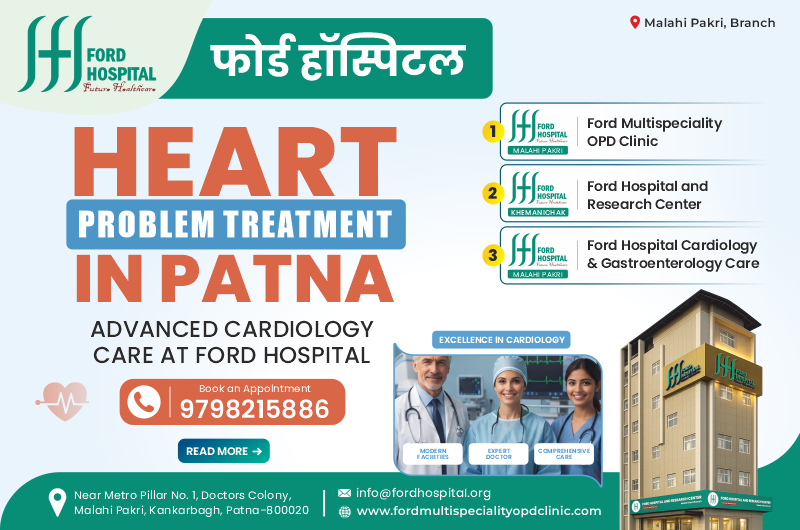
1 Ford Multispeciality OPD Clinic — Frontline Diagnosis, Medical Stabilization & Long-Term Prevention

For patients noticing early warning signs—such as borderline high blood pressure, occasional palpitations, mild exertional breathlessness, or a family history of heart disease—the Ford Multispeciality OPD Clinic serves as the primary frontline facility. Designed to provide a calm, dedicated outpatient environment free from emergency-room crowding, this clinic focuses on catching cardiovascular disease early and stabilizing chronic heart problems through non-invasive care.

  • First-Line Functional Cardiac Diagnostics: The clinic provides essential non-invasive testing, including resting 12-lead ECGs to evaluate electrical conduction, 2D Color Doppler Echocardiography to inspect valve function and measure Ejection Fraction (LVEF), and Treadmill Stress Testing (TMT) to detect hidden arterial blockages under supervised physical exercise.
  • Four-Pillar Pharmacological Management: For chronic conditions such as hypertension, stable angina, dyslipidemia, and compensated heart failure, cardiologists initiate and titrate Guideline-Directed Medical Therapy (GDMT)—balancing beta-blockers, ACE inhibitors/ARNIs, SGLT2 inhibitors, statins, and antiplatelets while tracking kidney function and electrolytes.
  • Post-Angioplasty & Post-Surgery Surveillance: Patients who have previously received coronary stents, pacemakers, or bypass grafts require lifelong outpatient follow-up. The clinic conducts scheduled medication reviews, blood-thinner adjustments, and structured lifestyle counseling to prevent recurrent cardiac events.

Because heart problems are closely driven by systemic conditions such as diabetes, kidney disease, thyroid imbalances, and respiratory disorders, the clinic integrates 12 outpatient specialties under one roof:

2 Ford Hospital & Research Center — 24×7 Emergency Resuscitation, Tertiary ICU & Open-Heart Surgery Hub

When a heart problem escalates into an acute life-threatening emergency, or when diagnostic angiography reveals complex structural defects requiring open-heart surgery, patients are treated at Ford Hospital & Research Center (located near New Bypass, Khemnichak, Patna). Operating as a 105-bedded multispeciality inpatient campus, this facility brings together emergency trauma triage, advanced Intensive Coronary Care Units (ICCU), an on-site Digital Cath Lab, and modular Cardiothoracic & Vascular Surgery (CTVS) theaters.

  • 24×7 Golden Hour Heart Attack Response: Equipped with Advanced Life Support (ALS) cardiac ambulances, immediate point-of-care Troponin biomarker testing, and round-the-clock emergency physicians, the hospital executes rapid door-to-balloon protocols for acute ST-Elevation Myocardial Infarction (STEMI) via emergency Primary Angioplasty.
  • Cardiothoracic & Vascular Surgery (CTVS): For patients with severe triple-vessel coronary artery disease, left main coronary trunk blockages, or calcified heart valves unsuitable for catheter stenting, our CTVS surgical unit performs Beating-Heart (Off-Pump) Coronary Artery Bypass Grafting (CABG), conventional on-pump bypass surgery, and surgical heart valve repair or replacement.
  • Critical Care & Multi-Organ Life Support: Patients presenting with acute decompensated heart failure, pulmonary edema (fluid in the lungs), or cardiogenic shock are stabilized in specialized ICCUs equipped with invasive arterial monitoring, mechanical ventilators, temporary pacemakers, Intra-Aortic Balloon Pumps (IABP), and bedside renal dialysis.

To support complex cardiac inpatients who have co-existing kidney, neurological, respiratory, or surgical emergencies, the main campus provides 24×7 multidisciplinary integration across 20 departments:

3 Ford Hospital Cardiology & Gastroenterology Care — Precision Interventional Cardiology, Rhythm Devices & Cardio-Gastric Synergy

Situated at Malahi Pakri, Kankarbagh, Patna, Ford Hospital Cardiology & Gastroenterology Care is a specialized dual-specialty institute built to handle high-precision catheter interventions, electronic cardiac device implantations, and the frequent clinical overlap between heart and digestive disorders.

  • “Radial-First” & Microscopic Image-Guided Stenting: Our interventional cardiologists prioritize transradial catheterization—performing coronary angiography and angioplasty through the wrist artery rather than the groin, which minimizes bleeding risk and allows earlier mobilization. To treat calcified or complex arterial blockages with precision, the Cath Lab utilizes Fractional Flow Reserve (FFR) to measure blood-pressure drops across a lesion, alongside Intravascular Ultrasound (IVUS) and Optical Coherence Tomography (OCT) to visualize the interior walls of the artery before and after stent placement.
  • Pacemakers, AICDs & Heart Failure Resynchronization (CRT): For patients whose heart problem stems from electrical conduction blocks or severely weakened pumping function (low LVEF), the center performs minimally invasive implantations of Permanent Pacemakers, Automated Implantable Cardioverter-Defibrillators (AICDs) to prevent sudden cardiac arrest, and Cardiac Resynchronization Therapy (CRT-P / CRT-D) devices to synchronize ventricular contraction.
  • Solving the Cardio-Gastric Overlap: Two major clinical challenges bring cardiology and gastroenterology together. First, severe acid reflux (GERD), esophageal spasms, and biliary colic frequently mimic heart pain, requiring coordinated cardiac and endoscopic testing. Second, patients who receive coronary stents must take Dual Antiplatelet Therapy (blood thinners), which can trigger gastric ulcers or internal GI bleeding in vulnerable individuals. Having senior cardiologists and gastroenterologists practicing side-by-side allows immediate therapeutic endoscopy to control bleeding without dangerously interrupting the medications protecting the heart stent.

Explore Our Dedicated Core Services:

  • Cardiology & Angioplasty Centre — Transradial angiography, FFR/IVUS/OCT-guided angioplasty, pacemaker/AICD/CRT implantation, ECMO support, and 24×7 CCU monitoring.
  • Gastroenterology & Hepatology — Upper GI endoscopy, colonoscopy, FibroScan liver assessment, and specialized GI protection for patients on blood thinners.

Branch Comparison Table: Selecting the Right Facility for Your Heart Problem

To help patients and caregivers choose the appropriate center without delay, the table below compares clinical capabilities across all three Ford Hospital locations:

Clinical Parameter#1 Ford Multispeciality OPD Clinic#2 Ford Hospital & Research Center (Khemnichak)#3 Ford Hospital Cardiology & Gastroenterology Care (Kankarbagh)
Primary Clinical RoleFrontline outpatient diagnosis, preventive heart checkups, and chronic medical therapy.24×7 multispeciality emergency hospital, tertiary ICCU, and open-heart surgery campus.Dedicated dual-specialty hub for image-guided catheter interventions and cardio-gastric care.
Best Suited ForHigh BP, high cholesterol, mild exertional breathlessness/angina, diabetes-heart screening, and post-op follow-ups.Acute heart attacks, severe pulmonary edema, triple-vessel blockages needing bypass (CABG), or valve surgery.Radial angiography, IVUS/OCT-guided stenting, pacemaker/CRT devices, or chest pain overlapping with gastric reflux.
Available Cardiac Diagnostics12-lead ECG, 2D Echo with Color Doppler, Treadmill Stress Test (TMT), and metabolic blood panels.24×7 Emergency ECG/Troponin triage, flat-panel Digital Cath Lab, CT/Radiology, and full inpatient labs.Transradial Digital Cath Lab, FFR physiological testing, IVUS & OCT imaging, 2D Echo, and GI Endoscopy.
Treatment CapabilitiesGuideline-Directed Medical Therapy (GDMT), medication titration, dietetics, and outpatient rehab.Primary PCI (Stenting), Beating-Heart CABG, Valve Repair/Replacement, IABP, and Dialysis/CRRT.Complex PCI (Angioplasty), Pacemaker, AICD & CRT-D implantation, ECMO, and therapeutic GI endoscopy.
Facility EnvironmentStreamlined daytime Outpatient Department (OPD).105-bedded Inpatient, Emergency & Surgical Hospital.24×7 Specialized Coronary Care Unit (CCU) & Interventional Center.

Clinical Directory: Our Cardiovascular & CTVS Medical Specialists

Treating complex heart problems safely requires a collaborative Heart Team where non-invasive cardiologists, interventional specialists, and cardiothoracic surgeons evaluate cases together. In accordance with NMC guidelines regarding transparent presentation of medical qualifications, below is the factual profile of our cardiac specialists along with their consultation links:

  • Dr. B. B. Bharti (MBBS, MD, DM – Interventional Cardiology): Serving as Director of Cardiology with more than 22 years of clinical experience in diagnostic coronary angiography, emergency and elective angioplasties, cardiac device implantations, and complex ischemic heart disease management.
  • Dr. Manmohan (MBBS, MS, MCh – Cardiothoracic & Vascular Surgery – CTVS): Lead CTVS Surgeon with over 34 years of surgical experience performing Beating-Heart Coronary Artery Bypass Grafting (CABG), complex heart valve replacements, and thoracic vascular procedures.
  • Dr. Sushant Kumar Pathak (MBBS, MD, DM – Interventional Cardiology): Consultant Interventional Cardiologist focusing on Golden Hour Primary PCI during acute heart attacks, structural interventions, and Optical Coherence Tomography (OCT) / IVUS-guided stent deployment.
  • Dr. Saroj Kr. Mishra (MBBS, MD, DM – Non-Invasive & Clinical Cardiology): Consultant Interventional Cardiologist specializing in the “Radial-First” wrist-access approach, physiology-guided coronary evaluations (FFR and IVUS), comprehensive echocardiography, and stress testing.
  • Dr. Jyoti Kumari (MBBS, MD, DrNB – Cardiology): Consultant Cardiologist dedicated to outpatient clinical cardiology, hypertension and lipid optimization, non-invasive cardiac diagnostics, and preventive heart care.
  • Dr. Vikash Kumar (MBBS, MD, DrNB – Cardiology): Consultant Cardiologist focusing on clinical cardiac triage, anti-anginal therapy titration, diagnostic evaluation of chest discomfort, and secondary prevention.
  • Dr. Shashank (MBBS, MD, DM – Clinical Cardiology & Heart Failure): Consultant Cardiologist specializing in Guideline-Directed Medical Therapy (GDMT) for chronic heart failure, weakened heart muscle (cardiomyopathy), and cardiac arrhythmia evaluation.

Diagnostic-to-Treatment Protocol: How a Heart Problem is Evaluated

To ensure every patient receives evidence-based care—avoiding unnecessary invasive procedures when medication suffices, while acting swiftly when mechanical repair is needed—our clinicians follow a structured 4-step protocol:

  1. Step 1: Non-Invasive Functional & Biomarker Assessment: Evaluation begins with a detailed clinical history, physical examination, blood panels (Lipid Profile, HbA1c, Serum Creatinine, TSH, and Troponin or NT-proBNP when indicated), a 12-lead ECG, and a 2D Echocardiogram. For patients with exertional symptoms, a Treadmill Test (TMT) checks for inducible ischemia.
  2. Step 2: Medical Stabilization & Risk Modification: If diagnostics reveal early-stage plaque buildup, hypertension, or mild ventricular dysfunction, treatment focuses on targeted medications, sodium and lipid dietary restriction, glycemic control, and supervised outpatient follow-up.
  3. Step 3: Physiological & Intravascular Mapping (Angiography + FFR/IVUS/OCT): When non-invasive tests indicate significant arterial narrowing, a transradial coronary angiogram is performed. If a blockage appears borderline (between 50% and 70% narrowing), FFR or IVUS/OCT is used to verify whether the blockage is truly restricting blood flow before deciding on a stent.
  4. Step 4: Targeted Revascularization, Device Implantation, or Surgery: Flow-limiting single or double-vessel blockages are treated with drug-eluting stents (PCI); electrical rhythm blocks or severe pump failure are supported with Pacemakers, AICDs, or CRT devices; and extensive multi-vessel or valvular defects are corrected surgically via CABG or valve replacement, followed by structured outpatient rehabilitation.

Frequently Asked Questions (FAQs)

1. Do all heart problems require angiography, stenting, or open-heart surgery?

No. A large proportion of cardiovascular conditions—including essential hypertension, early coronary plaque buildup, mild valvular leakage, and stable heart failure—can be effectively stabilized and managed with Guideline-Directed Medical Therapy (GDMT), dietary changes, and regular outpatient monitoring at our OPD clinic without requiring invasive procedures.

2. What is the difference between a Heart Attack, Heart Failure, and Cardiac Arrest?

Patients often confuse these three terms, but they represent different mechanisms:

  • Heart Attack (Myocardial Infarction) is a circulation (“plumbing”) problem where a sudden blood clot blocks an artery feeding the heart muscle.
  • Heart Failure is a chronic pumping problem where the heart muscle gradually becomes too weak or stiff to pump blood efficiently, causing fluid buildup and breathlessness.
  • Cardiac Arrest is an acute electrical problem where the heart’s electrical system malfunctions abruptly, causing the heart to stop beating altogether.

3. How do tools like FFR, IVUS, and OCT improve the safety of coronary angioplasty?

A standard angiogram only shows a two-dimensional shadow of the blood vessel. FFR (Fractional Flow Reserve) measures the actual blood pressure difference across a narrowing to prove whether a stent is truly needed. IVUS (Intravascular Ultrasound) and OCT (Optical Coherence Tomography) use miniature imaging catheters inside the artery to measure exact vessel diameter and calcium thickness, helping the cardiologist select the exact stent size and expand it fully for long-term durability.

4. Why is kidney and stomach monitoring important during heart problem treatment?

The heart, kidneys, and digestive tract are closely linked. Heart failure medications and angiographic contrast dyes require careful kidney monitoring (creatinine and eGFR checks) to protect renal function. Similarly, blood-thinning medications prescribed after heart attacks or stenting can irritate the stomach lining; co-management with gastroenterologists prevents gastric ulcers and bleeding while keeping the heart protected.

5. Is cashless treatment available for cardiac diagnostics and surgeries at Ford Hospital?

Yes. Ford Hospital operates a dedicated Third-Party Administrator (TPA) and insurance coordination desk that facilitates cashless hospitalization for coronary angiography, primary and elective angioplasty, pacemaker/ICD implantation, and CABG bypass or valve surgeries through major private health insurers and eligible government healthcare schemes, subject to policy terms and verification.

SHARE THIS ARTICLE

Leave a Reply

Your email address will not be published. Required fields are marked *