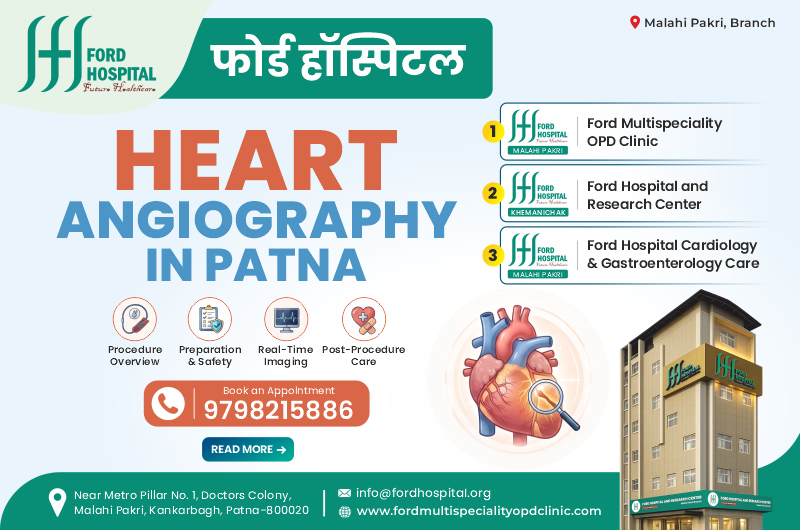
When a patient experiences recurring chest heaviness, unexplained breathlessness on climbing stairs, or an abnormal stress test, determining whether the heart’s arteries are obstructed becomes an urgent clinical priority. Heart angiography—referred to medically as Selective Coronary Angiography (CAG)—is the gold-standard diagnostic procedure used to visualize the interior channels of the coronary arteries. By introducing a slender, flexible catheter through a tiny puncture in the wrist (or groin) and injecting a small amount of radiopaque contrast medium under real-time X-ray fluoroscopy, an interventional cardiologist captures high-definition moving images of blood flowing through the heart’s vascular tree.
Across Patna and Bihar, clinicians are evaluating a growing number of adults in their thirties, forties, and fifties for premature Coronary Artery Disease (CAD)—a trend accelerated by Type 2 diabetes, unmanaged hypertension, dyslipidemia, tobacco consumption, and sedentary occupational routines. However, safe cardiovascular care does not begin by rushing every patient with chest discomfort straight onto a catheterization table. In evidence-based cardiology, a successful heart angiogram begins in the outpatient clinic with accurate pre-test risk stratification, kidney safety screening, and non-invasive functional testing, followed by precision catheter mapping and long-term medical management.
In strict adherence to the National Medical Commission (NMC) guidelines for factual, transparent, and non-promotional medical education, this comprehensive guide explains how cardiologists decide when a heart angiogram is truly needed, what happens before, during, and after the 15-minute radial procedure, and how the Ford Hospital network coordinates diagnostic, surgical, and outpatient cardiac care sequentially across three dedicated facilities in Patna.
One of the most frequent questions patients ask during a heart consultation is whether a resting 12-lead ECG and a 2D Echocardiogram are sufficient to check for blockages. In clinical practice, a resting ECG records the heart’s electrical activity while your body is lying completely still and myocardial oxygen demand is low; even an artery that is 70% to 80% narrowed can produce a completely normal resting ECG between pain episodes. Similarly, a 2D Echo uses ultrasound to measure heart muscle pumping strength (Left Ventricular Ejection Fraction – LVEF) and valve motion, but cannot resolve the millimeter-wide interior of the coronary vessels.
To avoid unnecessary invasive tests while ensuring dangerous blockages are never missed, cardiologists evaluate a patient’s Pre-Test Probability (PTP) based on specific clinical symptoms and non-invasive test triggers:
Understanding the clinical workflow of a heart angiogram removes much of the anxiety surrounding the test. Unlike open surgery, diagnostic coronary angiography requires no surgical incisions, no stitches, and no general anesthesia. The entire diagnostic journey follows four structured phases:
Before scheduling an elective angiogram, the cardiologist conducts a safety audit of your blood chemistry and daily prescriptions. Because angiographic contrast medium is cleared from the bloodstream by the kidneys, a Serum Creatinine and estimated Glomerular Filtration Rate (eGFR) test is mandatory. Patients taking metformin for diabetes are advised when to temporarily pause the tablet for 48 hours around the test, and patients taking oral anticoagulants (blood thinners for atrial fibrillation or prior clots) receive specific bridging instructions. A 4-to-6-hour fasting window is maintained prior to the scan.
Rather than using the traditional femoral artery in the groin—which required patients to lie flat on their backs for 6 to 8 hours after the test—modern interventional cardiology prioritizes Transradial Access (TRA) through the wrist. While you lie comfortably awake in the Digital Catheterization Laboratory (Cath Lab), the cardiologist numbs a small spot above your wrist crease with 1 to 2 mL of local anesthetic and places a thin, lubricated introducer sheath (less than 2 mm wide) into the radial artery.
A soft diagnostic catheter is guided smoothly up the arm vessel into the root of the aorta. Because the inside of blood vessels lacks pain receptors, you do not feel the catheter moving inside your body. Small puffs of kidney-safe (low-osmolar or iso-osmolar) contrast dye are injected while the flat-panel X-ray camera rotates to record high-frame-rate digital films of all four major coronary segments: the Left Main stem, the Left Anterior Descending (LAD), the Left Circumflex (LCX), and the Right Coronary Artery (RCA).
If the X-ray shadow shows a borderline narrowing between 50% and 69%, our cardiologists can pass a Fractional Flow Reserve (FFR) pressure-sensing wire to measure whether the plaque is actually restricting blood flow, or use miniature catheter cameras—Intravascular Ultrasound (IVUS) and Optical Coherence Tomography (OCT)—to inspect calcium thickness and plaque stability from inside the vessel.
Once the 15-to-20-minute cine-angiogram is complete, the thin catheter is removed and a transparent, cushioned radial compression wristband is applied over the wrist puncture. You can sit up immediately, drink water to flush out the contrast dye, eat a light meal within an hour, and—when no stenting is required—walk out of the hospital the same day within 4 to 6 hours.
Navigating a heart angiography safely requires matching the right clinical setting to your stage of evaluation: starting with an unhurried outpatient gatekeeper clinic to verify whether you need an angiogram and prepare your body safely, backed by a 24×7 tertiary multispeciality hospital for emergency and high-risk cardiorenal cases, and supported by a dedicated interventional cardiology and gastroenterology institute for day-care radial mapping.
For stable patients experiencing occasional chest tightness, palpitations, exertional breathlessness, or high cardiovascular risk from diabetes and hypertension, the Ford Multispeciality OPD Clinic serves as the primary frontline facility. Operating as a calm, crowd-free daytime outpatient center, the clinic currently provides specialized OPD consultations across Cardiology, Gastroenterology, Gynecology, Psychiatry, General & Laparoscopic Surgery, Internal Medicine, and Diabetes/Endocrinology.
Visiting the OPD clinic first ensures that an invasive angiogram is recommended only when non-invasive testing proves it is clinically warranted, and that your kidneys and metabolic profile are fully prepared beforehand:
Outpatient Specialty Directory at Ford Multispeciality OPD Clinic:
Located near New Bypass (NH-30), Khemnichak, Patna, Ford Hospital & Research Center functions as our flagship 105-bedded multispeciality inpatient, emergency, and cardiothoracic surgical campus. When a patient cannot wait for a daytime OPD appointment due to an acute heart attack, or when a patient has complex medical comorbidities that make routine angiography high-risk, this tertiary hospital provides 24×7 catheterization, intensive care, and surgical backup under one roof.
Complete 20-Department Multispeciality Directory at Ford Hospital & Research Center:
Located centrally at Malahi Pakri, Kankarbagh, Patna, Ford Hospital Cardiology & Gastroenterology Care functions as our specialized dual-specialty institute built for streamlined, wrist-access (Radial-First) coronary angiography, physiological plaque assessment, ad-hoc stenting, and the co-management of overlapping heart and digestive disorders.
When a patient’s OPD stress test or clinical profile indicates the need for a scheduled coronary angiogram, this focused institute offers three distinct advantages:
Explore Our Dedicated Core Services at Kankarbagh:
To help patients and family members select the appropriate Ford Hospital branch for pre-angiogram screening, emergency catheterization, or day-care radial angiography, review the comparison table below:
| Clinical Parameter | #1 Ford Multispeciality OPD Clinic | #2 Ford Hospital & Research Center | #3 Ford Cardiology & Gastro Care |
| Primary Role | Pre-CAG Gatekeeper & Post-CAG OPD Clinic | 24×7 Emergency CAG, ICCU & CTVS Campus | Day-Care Radial CAG, FFR/OCT & Gastro Hub |
| Location | Patna Outpatient Center | New Bypass, Khemnichak, Patna | Malahi Pakri, Kankarbagh, Patna |
| Ideal Patient | Initial chest pain checkup & mild plaque care | Emergency heart attack CAG & high creatinine | Scheduled wrist angiogram & GI pain overlap |
| Diagnostic Suite | Non-Invasive 12-Lead ECG, 2D Echo & TMT | 24×7 Digital Cath Lab, CT & Bedside Echo | Radial Digital Cath Lab, FFR, IVUS & OCT |
| Follow-On Care | GDMT Plaque Regression, Diabetes & Dietetics | Primary PCI, Beating-Heart CABG & Dialysis | Same-Sitting Stenting (PCI) & Endoscopy |
How to Use This Table:
Accurate interpretation of a coronary angiogram—and safe catheter navigation through the wrist artery—depends directly on the clinical experience of the cardiologist. In strict compliance with NMC ethical guidelines regarding transparent presentation of medical qualifications, below is our cardiac specialist directory with direct consultation links:
Within minutes of completing your 15-to-20-minute radial angiogram, the cardiologist sits down with your family to display the high-definition X-ray recordings and explain which of three clinical outcomes applies to you:
1. Why should I visit the Ford Multispeciality OPD Clinic before booking a Heart Angiography?
Unless you are experiencing an active medical emergency (severe resting chest pain or sweating), starting at the Ford Multispeciality OPD Clinic ensures you undergo a thorough non-invasive gatekeeper evaluation (12-lead ECG, 2D Echo, and Treadmill Stress Test) first. If non-invasive tests show low risk, you can safely avoid an invasive catheter test altogether. If an angiogram is needed, our OPD team checks your kidney function (Creatinine/eGFR) and adjusts diabetes or blood-thinner tablets beforehand so your day-care angiogram is completely safe.
2. What is the difference between a CT Coronary Angiogram and a Catheter Coronary Angiogram?
A CT Coronary Angiogram is an external X-ray scan useful for ruling out blockages in patients with low-to-intermediate risk, though heavy arterial calcium or a fast heart rate can sometimes blur the CT image. A Catheter (Conventional) Coronary Angiogram—performed inside a Digital Cath Lab via the wrist—remains the clinical gold standard because it provides real-time, high-frame-rate moving images of blood flow, allows direct measurement of pressure drops (FFR), and lets the cardiologist open a critical blockage with a stent in the exact same sitting if needed.
3. Is a wrist-access (Radial) heart angiogram painful, and how soon can I go home?
No, the procedure is not painful and does not require general anesthesia. You remain awake and comfortable while a tiny spot on your wrist is numbed with local anesthesia. Because the procedure uses the small radial artery in the wrist rather than the groin, you can sit up immediately after the 15-minute scan, walk within 2 hours, and return home the same day (within 4 to 6 hours) for a purely diagnostic angiogram.
4. Can patients with high Serum Creatinine or Kidney Disease undergo Heart Angiography safely?
Yes, with specialized Cardiorenal Precautions at Ford Hospital & Research Center. Our nephrologists and interventional cardiologists protect compromised kidneys by administering pre- and post-procedure intravenous saline hydration, holding nephrotoxic medications, using minimal volumes of kidney-safe iso-osmolar contrast dye, utilizing Intravascular Ultrasound (IVUS) to reduce dye usage, and providing 24×7 bedside dialysis backup when clinically indicated.
5. Is cashless insurance available for Heart Angiography and follow-on procedures at Ford Hospital?
Yes. While outpatient consultations and non-invasive screening tests (ECG, 2D Echo, TMT) at the Ford Multispeciality OPD Clinic are billed transparently at standard OPD rates, diagnostic coronary angiography and any required angioplasty or CABG surgery at Ford Hospital & Research Center and Ford Hospital Cardiology & Gastroenterology Care are supported by our 24×7 Third-Party Administrator (TPA) and insurance desks—facilitating cashless approvals across major private insurers and eligible government healthcare schemes, subject to policy terms.