Front Desk : +91 9798215886   | Address : MIG-207, Lohiya Nagar, Kankarbagh, Malahi Pakri , PATNA 800020 (Bihar).

Heart Care Center in Patna

Heart Care Center in Patna

Heart Care Center in Patna: An Integrated Clinical Guide to Preventive, Interventional, and Surgical Cardiology

Modern cardiovascular medicine extends far beyond treating sudden heart attacks in an emergency room. A structured heart care center operates as a complete clinical ecosystem—designed to detect silent arterial plaque before symptoms arise, stabilize chronic heart muscle weakness through targeted pharmacology, reopen blocked vessels using microscopic catheter imaging, and perform reconstructive open-heart surgery when structural repairs are required.

In Patna and across Bihar, clinicians are observing a noticeable shift in cardiovascular demographics. Conditions such as Coronary Artery Disease (CAD), hypertensive heart disease, and ischemic cardiomyopathy are increasingly affecting individuals in their late thirties and forties. This trend is largely driven by unmanaged metabolic syndrome, Type 2 diabetes, chronic occupational stress, tobacco consumption, and delayed preventive screening. Navigating heart care effectively requires understanding not only what symptoms demand attention, but also which medical facility is structured to handle your specific stage of cardiovascular health.

In strict adherence to the National Medical Commission (NMC) guidelines regarding factual, transparent, and non-promotional medical communication, this comprehensive guide outlines the clinical spectrum of heart diseases, evidence-based diagnostic and treatment protocols, and how the Ford Hospital network coordinates cardiovascular care across three distinct facilities in Patna.

The Spectrum of Conditions Managed at a Dedicated Heart Care Center & Warning Signs

The cardiovascular system functions through a delicate balance of mechanical pumping, coronary blood supply, valvar one-way flow, and electrical signaling. A disruption in any of these four mechanisms leads to distinct clinical conditions, each presenting with specific warning signs that patients and families should recognize:

  • Coronary Artery Disease (CAD) & Myocardial Ischemia: Caused by cholesterol plaque accumulation (atherosclerosis) narrowing the coronary arteries. Warning signs include exertional chest heaviness, squeezing, or tightness (angina) that radiates to the left arm, shoulder, neck, or jaw, as well as sudden, unyielding chest pressure at rest indicative of an acute myocardial infarction (heart attack).
  • Cardiac Arrhythmias & Conduction Disorders: Abnormalities in the heart’s natural electrical pacemaker (the sinoatrial and atrioventricular nodes). Patients typically experience palpitations (a racing, fluttering, or skipped heartbeat), unexplained lightheadedness, sudden blackouts (syncope), or abnormally slow pulse rates (bradycardia).
  • Heart Failure & Cardiomyopathies: A progressive reduction in the heart muscle’s ability to contract (Reduced Ejection Fraction) or relax properly. Key clinical indicators include dyspnea (shortness of breath during routine walking or while lying flat in bed), waking up gasping for air at night, profound physical exhaustion, and bilateral pedal edema (swelling in the feet, ankles, and lower legs).
  • Valvular & Structural Heart Defects: Stenosis (narrowing) or regurgitation (leakage) of the mitral, aortic, tricuspid, or pulmonary valves—often linked to age-related calcification, congenital anomalies, or rheumatic fever history. Symptoms include progressive exercise intolerance, heart murmurs detected on auscultation, and chest discomfort.
  • Cardiometabolic & Vascular Overlaps: Systemic conditions where uncontrolled hypertension, chronic kidney disease, or diabetes accelerate vascular stiffness, increasing the combined risk of coronary events and cerebrovascular strokes.

Clinical Triage Note: Approximately 75% to 80% of chronic cardiovascular conditions—such as hypertension, stable angina, dyslipidemia, and compensated heart failure—can be diagnosed, stabilized, and monitored safely in an outpatient clinical setting when addressed early, preventing the need for emergency hospitalization.

Our Stepped-Care Cardiac Network in Patna: Matching Clinical Need to Facility Capability

Rather than routing every cardiac patient through a crowded emergency hospital, the Ford Hospital network utilizes a stepped-care clinical model across Patna. Care is organized sequentially: prioritizing accessible outpatient evaluation and long-term disease reversal first, backed by a 24×7 tertiary surgical and intensive care campus, and supported by a specialized dual-specialty interventional hub.

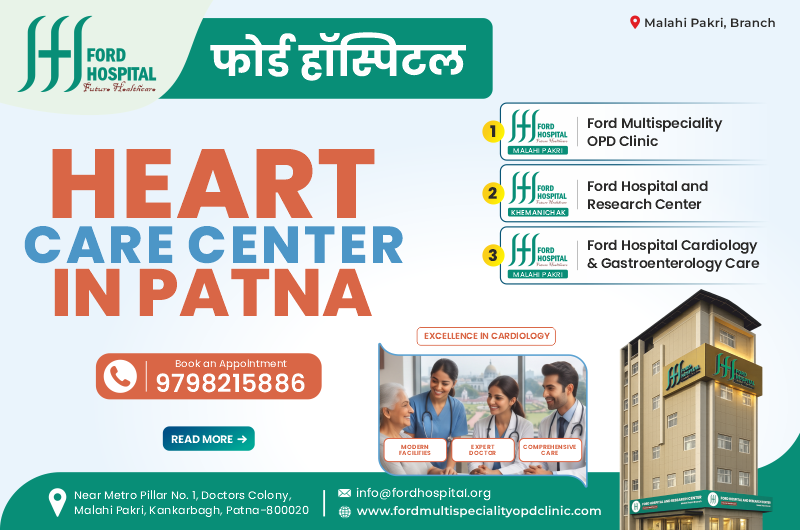
1. Ford Multispeciality OPD Clinic (The Frontline of Heart Health)

For individuals seeking preventive heart checkups, evaluation of mild or exertional symptoms, second opinions on chronic cardiac conditions, or structured post-surgery follow-ups, the Ford Multispeciality OPD Clinic serves as the primary frontline facility. Designed specifically as a streamlined outpatient environment, it separates routine cardiovascular care from acute inpatient hospital traffic—allowing for thorough consultations and systematic diagnostic workups.

  • Comprehensive Non-Invasive Cardiac Lab: The clinic performs foundational functional and structural heart assessments, including resting 12-lead Electrocardiography (ECG), 2D Color Doppler Echocardiography to measure Left Ventricular Ejection Fraction (LVEF) and valve gradients, Treadmill Stress Testing (TMT) to uncover exercise-induced ischemia, and ambulatory blood pressure or rhythm tracking.
  • Guideline-Directed Medical Therapy (GDMT) Optimization: Managing conditions like chronic heart failure, hypertension, or stable coronary disease requires careful, step-wise titration of cardioprotective medications (such as ARNIs, beta-blockers, SGLT2 inhibitors, antiplatelets, and high-intensity statins). Cardiologists here closely track renal parameters, potassium levels, and blood pressure to optimize drug dosages safely.
  • Lifecycle Preventive & Post-Procedural Care: Whether a patient is managing pre-existing diabetes to prevent heart disease or recovering after coronary stenting or bypass surgery, the clinic coordinates long-term lifestyle modification, dietary sodium/lipid control, and physical rehabilitation.

Because cardiovascular health is deeply interconnected with endocrine, renal, neurological, and respiratory function, the clinic provides integrated access to allied outpatient specialties under one roof:

  • Cardiology & Angioplasty Centre — Comprehensive outpatient cardiac consultations, ECG, 2D Echo, TMT, and long-term medical management.
  • Endocrinology — Specialized control of Type 2 diabetes, thyroid disorders, and metabolic syndrome that directly impact coronary arteries.
  • Nephrology & Dialysis Centre — Outpatient monitoring of kidney function (eGFR and creatinine) and management of hypertension-related renal changes.
  • Pulmonology & Respiratory Care — Differential evaluation of chronic shortness of breath, sleep apnea, and cardiopulmonary conditions.
  • Gastroenterology & Hepatology — Outpatient workup of gastroesophageal reflux (GERD) mimicking cardiac pain and fatty liver disease management.
  • Dietetics & Nutrition — Evidence-based therapeutic meal planning for cholesterol reduction, glycemic control, and fluid-restricted heart failure diets.
  • Physiotherapy & Rehabilitation — Structured outpatient cardiac rehabilitation and graded exercise conditioning to rebuild stamina safely.
  • Neurology – including Brain-Stroke Unit — Preventive care for atrial fibrillation-related stroke risks, carotid artery disease, and syncope evaluation.
  • Urology & Kidney-Stone Clinic — Outpatient urological care tailored for older patients on cardiac medications.
  • Orthopedics – Knee Replacement — Management of degenerative joint conditions to help cardiac patients maintain an active, mobile lifestyle.
  • OBS and Gynaecology — Specialized management of pregnancy-induced hypertension (preeclampsia) and perimenopausal cardiovascular shifts.
  • Pediatrics & Child Hospital — Outpatient pediatric evaluation for congenital heart murmurs, rheumatic fever prophylaxis, and childhood growth.

2. Ford Hospital And Research Center — Comprehensive Tertiary Healthcare Hub

When a cardiovascular condition requires emergency resuscitation, complex open-heart surgery, or intensive multi-organ life support, patients are managed at Ford Hospital & Research Center (located near New Bypass, Khemnichak, Patna). Serving as the flagship tertiary inpatient and surgical campus of the network, this hospital combines 24×7 emergency readiness with comprehensive surgical and critical care infrastructure.

  • Golden Hour Emergency Triage & Primary PCI: In an acute ST-Elevation Myocardial Infarction (STEMI / major heart attack), every minute of delayed blood flow increases permanent heart muscle damage. The hospital operates a 24×7 emergency cardiac protocol supported by Advanced Life Support (ALS) ambulances, immediate point-of-care Troponin testing, and an on-site flat-panel Digital Catheterization Laboratory (Cath Lab) for emergency Primary Angioplasty.
  • Cardiothoracic & Vascular Surgery (CTVS): Patients diagnosed with complex triple-vessel coronary artery disease, left main stem stenosis, severe heart valve calcification, or congenital structural defects require surgical reconstruction. The hospital houses dedicated modular CTVS operating suites equipped with heart-lung bypass machines and cell-salvage technology to perform Beating-Heart (Off-Pump) CABG, conventional bypass surgery, and heart valve repair or replacement.
  • Intensive Coronary Care Unit (ICCU) & Mechanical Support: Patients experiencing cardiogenic shock, acute pulmonary edema, or post-operative recovery are managed in high-dependency ICCUs equipped with invasive arterial line monitoring, mechanical ventilators, temporary pacing, and Intra-Aortic Balloon Pump (IABP) counterpulsation.

To ensure complete safety for high-risk cardiac inpatients who also suffer from kidney failure, stroke risks, or surgical emergencies, the main campus integrates 20 inpatient and surgical departments:

3. Ford Hospital Cardiology & Gastroenterology Care

Located centrally at Malahi Pakri, Kankarbagh, Patna, Ford Hospital Cardiology & Gastroenterology Care functions as a specialized dual-specialty institute focusing on precision catheter interventions, cardiac rhythm devices, and the clinical overlap between cardiovascular and gastrointestinal medicine.

  • Radial-First & Image-Guided Coronary Interventions: Interventional cardiologists at this center prioritize the transradial approach—performing angiographies and angioplasties through the radial artery in the wrist rather than the groin. This approach significantly reduces access-site bleeding and allows patients to sit up and walk much sooner after the procedure. To treat complex, calcified, or bifurcated coronary blockages accurately, the Cath Lab utilizes Intravascular Ultrasound (IVUS), Optical Coherence Tomography (OCT), and Fractional Flow Reserve (FFR)—measuring the exact pressure drop across a narrowing before placing a stent.
  • Cardiac Rhythm & Heart Failure Device Therapy: For patients suffering from dangerous electrical conduction blocks, life-threatening ventricular arrhythmias, or severe heart muscle weakness, the center performs minimally invasive implantations of Dual-Chamber Permanent Pacemakers, Automated Implantable Cardioverter-Defibrillators (AICDs), and Cardiac Resynchronization Therapy (CRT-P / CRT-D) devices.
  • Co-Management of the Cardio-Gastric Axis: In clinical practice, heart and digestive disorders intersect constantly. Not only do esophageal spasms and severe acid reflux mimic angina, but cardiac patients placed on mandatory Dual Antiplatelet Therapy (DAPT—such as Aspirin plus Clopidogrel or Prasugrel) face an elevated risk of gastric erosions and upper GI bleeding. Having senior cardiologists and gastroenterologists collaborating daily in the same building ensures accurate differential diagnosis and safe endoscopic and pharmacological protection of the digestive tract without compromising cardiac stent safety.

Explore Our Dedicated Core Services:

Branch Comparison Table: Navigating the Ford Hospital Cardiac Ecosystem

To help patients and family members select the appropriate facility based on clinical urgency and required treatment, the matrix below compares the three centers across key operational parameters:

Clinical & Operational Parameter#1 Ford Multispeciality OPD Clinic#2 Ford Hospital & Research Center (Khemnichak)#3 Ford Hospital Cardiology & Gastroenterology Care (Kankarbagh)
Core Facility DesignationPrimary Outpatient Diagnostic, Preventive & Chronic Disease Management Center.Flagship 24×7 Multispeciality Emergency, Tertiary ICU & Cardiothoracic Surgery Hospital.Dedicated Dual-Specialty Interventional Cardiology & Gastroenterology Institute.
When to Choose This BranchRoutine heart checkups, blood pressure/cholesterol control, mild exertional chest pain, or post-surgery follow-ups.Acute heart attacks, severe breathlessness, multi-vessel blockages needing bypass surgery (CABG), or multi-organ emergencies.Elective/emergency angiography & stenting, pacemaker/CRT implantation, or chest pain overlapping with severe gastric issues.
Diagnostic Capabilities12-lead ECG, 2D Echo with Color Doppler, Treadmill Stress Test (TMT), and comprehensive metabolic blood panels.24×7 Emergency Troponin/ECG triage, Digital Cath Lab, CT/Radiology suite, and complete inpatient pathology.Transradial Digital Cath Lab, FFR physiological testing, IVUS/OCT intracoronary imaging, 2D Echo, and GI Endoscopy.
Therapeutic & Surgical ScopeNon-invasive Guideline-Directed Medical Therapy (GDMT), medication titration, dietetics, and cardiac rehab.Primary PCI (Stenting), Beating-Heart CABG (Bypass Surgery), Heart Valve Repair/Replacement, and Dialysis/CRRT.Complex PCI (Angioplasty), Pacemaker, AICD & CRT-D implantation, and therapeutic GI endoscopy.
Care FormatDaytime Outpatient Department (OPD) with zero inpatient crowd friction.24×7 Inpatient Admissions, ICCU, Modular Operating Theaters & Emergency Triage.24×7 Specialized Coronary Care Unit (CCU), Interventional Suites & Inpatient Wards.

The Multidisciplinary Cardiovascular Medical Team

Delivering evidence-based heart care requires collaboration between non-invasive diagnosticians, interventional cardiologists, cardiothoracic surgeons, and allied medical specialists. In compliance with NMC regulations regarding objective presentation of practitioner credentials, below is the clinical profile of our cardiovascular team complete with their professional consultation links:

  • Dr. B. B. Bharti (MBBS, MD, DM – Interventional Cardiology): Director of Cardiology with more than 22 years of clinical experience in complex coronary interventions, diagnostic catheterizations, and structural heart disease management.
  • Dr. Manmohan (MBBS, MS, MCh – Cardiothoracic & Vascular Surgery): Senior CTVS Surgeon with over 34 years of surgical experience performing Beating-Heart Coronary Artery Bypass Grafting (CABG), valve replacements, and thoracic vascular repairs.
  • Dr. Sushant Kumar Pathak (MBBS, MD, DM – Interventional Cardiology): Consultant Interventional Cardiologist focusing on acute Primary PCI during myocardial infarctions, intracoronary imaging (OCT/IVUS), and structural heart interventions.
  • Dr. Saroj Kr. Mishra (MBBS, MD, DM – Non-Invasive & Clinical Cardiology): Consultant Interventional Cardiologist specializing in “Radial-First” transradial interventions, physiology-guided stenting (FFR, IVUS), echocardiography, and preventive outpatient cardiology.
  • Dr. Jyoti Kumari (MBBS, MD, DrNB – Cardiology): Consultant Cardiologist dedicated to clinical cardiac triage, hypertension and lipid management, non-invasive stress testing, and secondary prevention.
  • Dr. Vikash Kumar (MBBS, MD, DrNB – Cardiology): Consultant Cardiologist specializing in diagnostic evaluations, anti-anginal therapy titration, and outpatient cardiac risk stratification.
  • Dr. Shashank (MBBS, MD, DM – Clinical Cardiology & Heart Failure): Consultant Cardiologist focusing on advanced heart failure therapy optimization, cardiomyopathy management, and clinical arrhythmia evaluation.

The 4-Stage Clinical Pathway: How Heart Care is Delivered

Across the Ford Hospital network, patient management follows a structured, step-wise clinical protocol designed to avoid unnecessary invasive procedures while ensuring timely intervention when required:

  1. Stage 1 – Non-Invasive Functional & Biochemical Profiling: Every stable patient begins with a detailed clinical history, lipid and glycemic profiling (HbA1c, Lipoprotein markers), a 12-lead ECG, and a 2D Echocardiogram. If coronary narrowing is suspected, a Treadmill Stress Test (TMT) evaluates how the heart performs under physical workload.
  2. Stage 2 – Guideline-Directed Medical Therapy (GDMT): When arterial narrowing is mild-to-moderate or heart muscle weakness is detected early, cardiologists initiate evidence-based pharmacological therapy to control blood pressure, reduce myocardial oxygen demand, clear excess fluid, and stabilize arterial plaque.
  3. Stage 3 – Precision Catheter Revascularization & Rhythm Synchronization: If non-invasive testing reveals significant ischemia—or if a patient arrives with an acute heart attack—a coronary angiogram maps the exact arterial anatomy. Flow-limiting blockages are opened via drug-eluting stents (PCI) guided by IVUS/OCT, while electrical conduction defects are corrected with pacemakers, AICDs, or CRT devices.
  4. Stage 4 – Surgical Reconstruction & Long-Term Cardiac Rehabilitation: When coronary blockages involve multiple vessels or the left main trunk—especially in diabetic patients—the Heart Team coordinates Coronary Artery Bypass Grafting (CABG) or valve surgery, followed by structured outpatient physiotherapy, nutritional counseling, and scheduled OPD surveillance to protect long-term recovery.

Frequently Asked Questions (FAQs)

1. What is the difference between visiting a standalone clinic and an integrated Heart Care Center?

A standalone clinic typically offers basic consultations and resting ECGs, requiring patients to travel to separate diagnostic centers or hospitals if advanced testing or procedures are needed. An integrated heart care network like Ford Hospital connects outpatient preventive screening (Ford Multispeciality OPD Clinic) directly with precision catheter labs (Ford Hospital Cardiology & Gastroenterology Care) and 24×7 open-heart surgical backup (Ford Hospital & Research Center), ensuring continuity of medical records and seamless escalation of care.

2. How does a “Heart Team” decide between coronary stenting (angioplasty) and open-heart bypass surgery (CABG)?

In modern cardiology, complex cases are reviewed jointly by an interventional cardiologist and a cardiothoracic surgeon. Single- or double-vessel blockages in accessible locations are generally treated with minimally invasive angioplasty and drug-eluting stents. However, if a patient has extensive triple-vessel disease, severe left main coronary artery narrowing, or accompanying heart valve defects—particularly alongside diabetes—CABG surgery often provides superior long-term vessel patency and survival benefits.

3. What is “Radial-First” angiography, and how does it benefit the patient?

Traditionally, coronary angiography was performed by inserting a catheter through the femoral artery in the groin, which required the patient to lie completely flat for 6 to 8 hours afterward to prevent bleeding. In a “Radial-First” approach, the cardiologist accesses the heart through the small radial artery in the wrist. This technique significantly lowers the risk of local bleeding complications, causes less post-procedural discomfort, and allows most diagnostic patients to sit up and walk shortly after the test.

4. At what age should adults in Patna start routine preventive heart screenings?

Given the higher genetic and metabolic predisposition to early-onset coronary disease in India, clinicians recommend establishing a baseline cardiovascular profile (fasting lipid panel, blood glucose/HbA1c, blood pressure check, and resting ECG) by age 30 to 35. Individuals with a family history of premature heart attacks, active smokers, or those already diagnosed with diabetes or hypertension should undergo annual evaluations including a 2D Echo or TMT as advised by their cardiologist.

5. Does Ford Hospital provide cashless insurance and government scheme support for cardiac treatments?

Yes. Ford Hospital maintains a dedicated Third-Party Administrator (TPA) and insurance desk across its inpatient facilities. We facilitate cashless hospitalization and treatment approvals for diagnostic angiographies, emergency angioplasties, pacemaker implantations, and CABG/valve surgeries under recognized private health insurance providers and eligible government healthcare schemes, subject to standard policy terms and verification.

SHARE THIS ARTICLE

Leave a Reply

Your email address will not be published. Required fields are marked *